When can you contact me?

Important! If there is a psychiatric diagnosis or if pharmacotherapy is necessary, I work exclusively in collaboration with a psychiatrist.

01
Self-doubt, feelings of helplessness
02
Procrastination, feeling stuck, and lack of motivation
03
Issues of self-worth and self-realization
04
Emotional instability
05
Anxiety, fears, and phobias
06
Neurotic and emotional disorders
07
Depression, apathy, and panic attacks
08
Symptoms of PTSD (post-traumatic stress disorder)
09
Borderline Personality Disorder (BPD), Narcissistic Personality Disorder (NPD)
10
Lack of mutual understanding in relationships, constant conflicts
11
Difficulties in relationships after the birth of a child
12
Family and professional relationships, conflict resolution

I work according to the principle of “here and now.”

Each person, having their own traumas, experiences them and interacts with others in unique ways.

Our main goal is to identify these reactions during the sessions. We analyze them and, if possible, encourage change—first during sessions, then in real life.

At the same time, great importance is placed on the patient’s feelings, fantasies, and desires, as the main goal is to improve their real life.

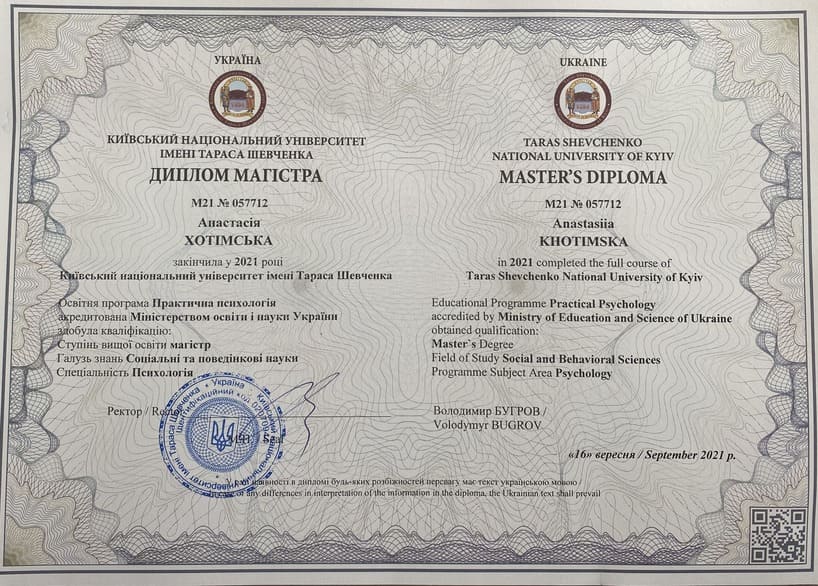
Khotimska Anastasiia
  • 7 years of experience
  • 1500+ hours of practice

Practical Experience:

  • I have maintained a private psychotherapeutic practice since 2019.
  • PhD student in the DPPClinPrac (Doctorate in Psychotherapeutic Psychoanalytic Clinical Practice) program at the University of Exeter.
  • Member of the Division of Psychoanalytic Psychology and Psychotherapy at the National Psychological Association of Ukraine.
  • Certified psychotherapist in the TFP model and member of the Ukrainian Group of TFP Therapists.
  • Expert contributor to psychological television programs and lecturer at psychological events and round tables.
  • Volunteer psychologist in group therapy for internally displaced persons (IDPs) at the Charitable Foundation “CO Resolute Hearts” since March 2023.
  • Worked as a psychologist in adolescent group therapy at the Business Orientation Centre from 2017 to 2019.
  • Volunteer assistant to an art therapist at the Dnipropetrovsk Clinical Military Hospital from 2017 to 2018.

Services and Fees

location
Available online or in person
Individual Adult Therapy
We work based on your personal concerns or overall emotional state.
  • Session fee: 2500 UAH
  • Duration: 50 minutes
Sign up for a consultation
Couples Therapy
Therapy for couples seeking to resolve specific issues and improve their relationship.
  • Session fee: 3500 UAH
  • Duration: 1.5 hours
Sign up for a consultation
Group Events: Seminars and Lectures
These may be conducted in the form of seminars, lectures, or group therapy sessions.
Examples of topics+
  • Session fee: Starting from 3000 UAH per hour Final cost depends on the format, duration, and number of participants.
Contact for more details and availability

What to Expect When Working With Me

Before beginning therapy, we will conduct 1–2 diagnostic sessions. During these sessions, I will provide feedback and let you know whether I can take you into therapy and what options are available.

The cost of diagnostic sessions depends on the chosen service and is paid in advance.

Khotimska Anastasiia
Diagnostic Sessions Include:
  • Initial meeting (online or in person) and introduction
  • Discussion of your requests, or help in formulating them if they are not yet clear
  • A detailed interview to better understand your personality
  • Involving loved ones, if necessary
  • Providing feedback on the potential direction of further work
Therapeutic Sessions:
  • A space where you can speak freely about anything that troubles you
  • I may ask guiding questions and offer therapeutic hypotheses
  • You are encouraged to share your thoughts and reactions to the process
  • Together, we analyze experiences, thoughts, and emotions, creating opportunities for growth and change

Reviews From My Clients:

Good evening! Thank you for the sessions—the last three have been especially meaningful for us. I can truly say that Roma and I are doing well. We’ll continue with therapy next week as usual! 🙂
Thank you so much for your support. I’m hardly experiencing any attacks now, and when they do happen, I try not to focus on them.
Anastasiia, good afternoon! Our family is deeply grateful to you. You’ve helped us truly listen to and understand each other. For the first time in a long while, we’re able to express our emotions without hurting one another. Thank you!
Good afternoon! Thank you! I’ll definitely share our progress with you soon, once I sort everything out. Spoiler: we did a great job—and the results are visible!
Anastasiia, thank you so much for today’s session. I’m always so glad to come to you—it means a lot to me! I feel relieved, calm, and able to analyze the situation clearly now.

Frequently Asked Questions:

How often do I need to go to therapy?
Session frequency is determined individually and can range from 1 to 3 times per week. The most common frequency is twice a week. For maintenance therapy, once every two weeks is also possible.
How quickly can I solve my problem?
The time required to resolve each issue is highly individual and depends on your personality structure. After a structured interview, I typically provide feedback on the nature of the issue and offer an approximate timeline for resolution.
Are the counselling sessions strictly confidential?
Yes, all sessions—both online and in-person—are strictly confidential. If needed, this can be confirmed through a verbal or written agreement.
Who Do I Need: A Psychologist, Psychotherapist, or Psychiatrist?
Let’s clarify these terms to avoid confusion about who can best support you.

A psychologist is a specialist who provides consultations based on psychological knowledge. They may not have formal medical training, do not prescribe medication, and cannot make official diagnoses. However, they help individuals improve their relationships with themselves and the world around them.

A psychotherapist helps clients work through deep psychological traumas. They typically have higher medical or psychological education, conduct necessary diagnostics for the rehabilitation of individuals with severe mental health conditions or personality disorders, but do not prescribe medication.

A psychiatrist is a medical doctor who diagnoses mental health disorders and prescribes medication. They understand the organic and biochemical structure of the human psyche, as well as the causes and mechanisms of psychological illnesses. They are trained to distinguish between normal and pathological states.

If necessary, one specialist can refer you to another.
How do I know if I need a Psychologist?
To begin therapy, you need to have a request or concern. Sometimes clients are aware of their concerns from the start, while in other cases, these are identified during psychodiagnostics sessions.

A request refers to what you want to achieve, gain, or change. In other words, if you want to change, acquire, or let go of something in your life, this may be a reason to seek help from a psychologist or psychotherapist.
What requests do you not work with?
– I do not work with individuals under the age of 18.

– I do not work with cases involving addiction (alcohol or drugs), antisocial disorders (such as pedophilia, necrophilia, zoophilia, etc.), psycho-emotional disorders of organic origin, or sexual perversions.
What guarantees can you provide?
I guarantee confidentiality, as well as my full presence, interest, and engagement during each session. I take full responsibility for creating a safe therapeutic environment (in online sessions, this is a shared responsibility), for my interpretations, diagnoses, and feedback.

You are responsible for your own actions and decisions.
How is couple therapy conducted?
Couple therapy typically begins with 1–2 diagnostic sessions involving a structured interview and feedback. During this stage, I offer my perspective on potential therapy goals and we agree on the frequency of sessions.

It’s important to note that therapy can only proceed if both partners are willing and committed. A therapist cannot force change in the relationship.

During ongoing sessions, we explore the couple’s key issues—analyzing both verbal and non-verbal communication. I provide interpretations and may suggest specific “tasks” or exercises.

If needed, the couple may temporarily attend individual sessions before reuniting for joint sessions.

Important: A therapist cannot make you love (or stop loving) another person, nor can they guarantee reconciliation.
What topics are most frequently raised during group work?
– Emotional distress during wartime—how to recognize and manage it
– Anxiety in children and adolescents during war—how to help and what to observe
– Searching for inner stability and meaning during times of crisis
– The rise in divorce rates during wartime—causes and coping strategies
– Conflicts with relatives or colleagues—how different coping styles lead to tension and how to rebuild healthy relationships
– Other topics may be addressed upon request